-
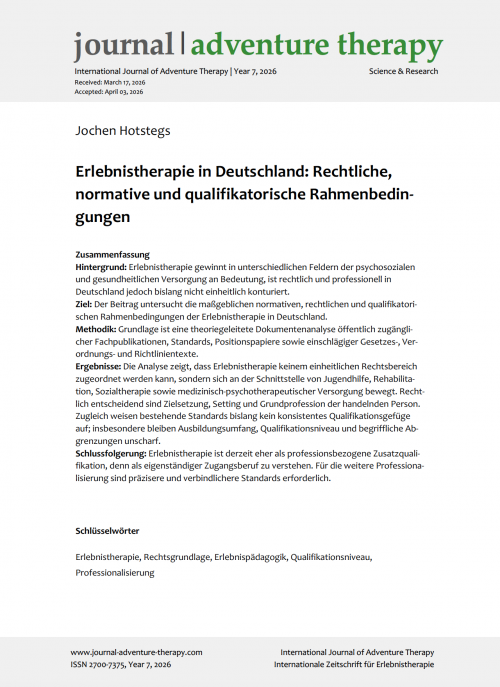 Hintergrund: Erlebnistherapie gewinnt in unterschiedlichen Feldern der psychosozialen und gesundheitlichen Versorgung an Bedeutung, ist rechtlich und professionell in Deutschland jedoch bislang nicht einheitlich konturiert. Ziel: Der Beitrag untersucht die maßgeblichen normativen, rechtlichen und qualifikatorischen Rahmenbedingungen der Erlebnistherapie in Deutschland. Methodik: Grundlage ist eine theoriegeleitete Dokumentenanalyse öffentlich zugänglicher Fachpublikationen, Standards, Positionspapiere sowie einschlägiger Gesetzes-, Verordnungs- und Richtlinientexte. Ergebnisse: Die Analyse zeigt, dass Erlebnistherapie keinem einheitlichen Rechtsbereich zugeordnet werden kann, sondern sich an der Schnittstelle von Jugendhilfe, Rehabilitation, Sozialtherapie sowie medizinisch-psychotherapeutischer Versorgung bewegt. Rechtlich entscheidend sind Zielsetzung, Setting und Grundprofession der handelnden Person. Zugleich weisen bestehende Standards bislang kein konsistentes Qualifikationsgefüge auf; insbesondere bleiben Ausbildungsumfang, Qualifikationsniveau und begriffliche Abgrenzungen unscharf. Schlussfolgerung: Erlebnistherapie ist derzeit eher als proffessionsbezogene Zusatzqualifikation, denn als eigenständiger Zugangsberuf zu verstehen. Für die weitere Professionalisierung sind präzisere und verbindlichere Standards erforderlich.
 -
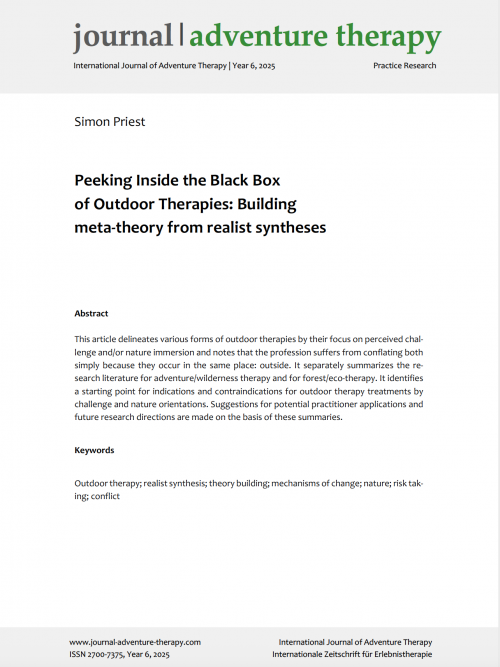
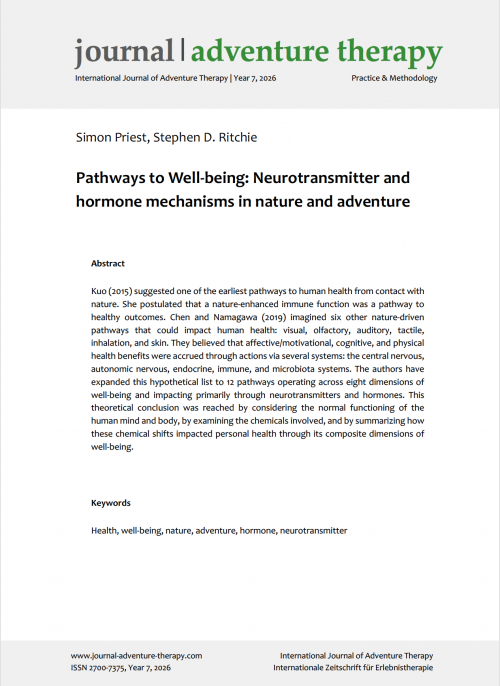 Kuo (2015) suggested one of the earliest pathways to human health from contact with nature. She postulated that a nature-enhanced immune function was a pathway to healthy outcomes. Chen and Namagawa (2019) imagined six other nature-driven pathways that could impact human health: visual, olfactory, auditory, tactile, inhalation, and skin. They believed that affective/motivational, cognitive, and physical health benefits were accrued through actions via several systems: the central nervous, autonomic nervous, endocrine, immune, and microbiota systems. The authors have expanded this hypothetical list to 12 pathways operating across eight dimensions of well-being and impacting primarily through neurotransmitters and hormones. This theoretical conclusion was reached by considering the normal functioning of the human mind and body, by examining the chemicals involved, and by summarizing how these chemical shifts impacted personal health through its composite dimensions of well-being.
 -
 This article presents a metaphor based on therapeutic intentionality that has utility for both adventure and nature-based therapists and outdoor leaders, though each group may use it differently. Clinically trained therapists can apply the construct directly in their work; the metaphor is compatible with many evidence-based methods and therapeutic approaches, but is perhaps most relevant to those that are insight oriented. Outdoor leaders, on the other hand, can use this construct to increase their understanding of the therapeutic processes they may observe, and sometimes be asked to be a part of, when working in therapeutic programs and to better recognize the critical distinctions between clinically trained therapists and outdoor leaders who may facilitate therapeutic experiences. This understanding helps outdoor leaders recognize appropriate boundaries of their competence, thus clarifying what falls within their scope of practice and what requires clinical training and possibly specialized credentials.
 -
 Simon Priest, Ping Liao, Denise Mitten, Christian Itin, Lee Gillis
 -
 Authors:
Simon Priest & Ellen Behrens
-
 Authors:
Priest, S., Gass, M.A., Javorski, S. & Bostick, K.
-
Authors:
Simon Priest & Steve Javorski
-
 Author:
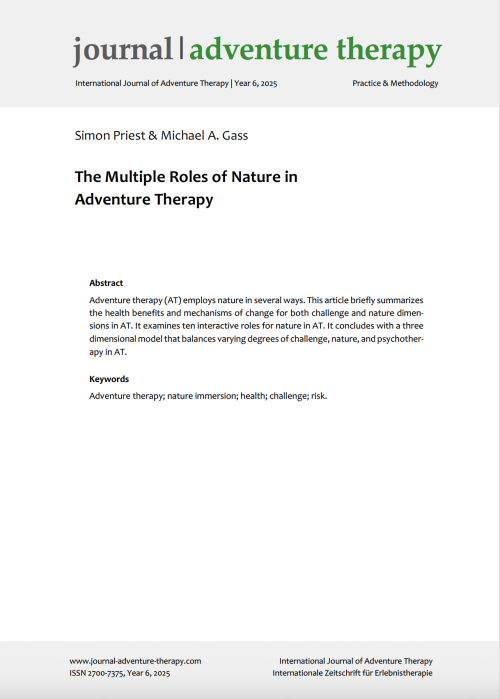
Simon Priest & Michael A. Gass
-
 Authors: Alexander Rose & Paloma Martínez
 -
Sale!
 Buy a voucher for 10 items now and get two items for free. Savings: 5 Euro!
 -
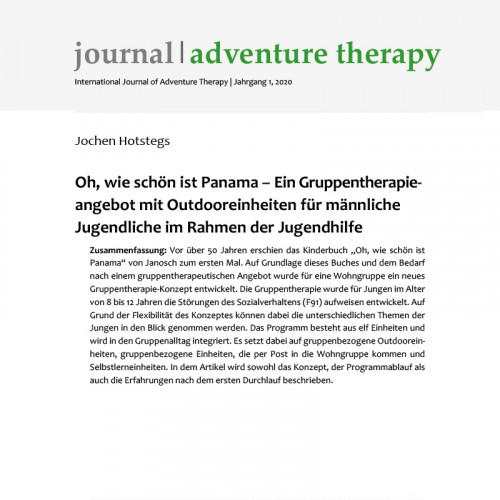 Author: Jochen Hotstegs
 -
 Author: Paul Hemmelmayr
 -
 Authors: Jochen Hotstegs
 -
 Authors: Corinna Fleischer, M.Sc. Psych.
 -
Authors: Thomas Klein-Isberner, Katja Wenzel
-
 Authors: Lynn Van Hoof, Alexander Rose & Harpa Ýr Erlendsdóttir
 -
 Author: Annette Bergmann